 It might not appear so at first, but ‘refreshing’ items for a writer is a wide and varied area of responsibility. Refreshment is important – because it is for the writer’s personal benefit.
*
Let’s make a list …
1. Project list
2. Website, blog, and social networks
3. Personal bio and author photo
4. Book covers
5. Book supplementary content
6. Book pricing
7. Appointments
8. To be Read (TBR)
9. Work in Progress (WIP)
10. Take regular breaks
*
1. Project List 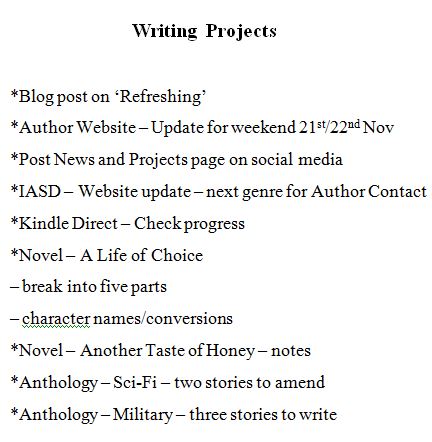
As a priority, we must strive to maintain separate writing and domestic ‘to do’ lists.
A good way to deal with this is to differentiate between domestic and writing.
Refer to domestic ‘tasks,’ but writing ‘projects’.
In the domestic tasks list add in a heading – Writing Projects. To the right is an example of my present Writing Projects.
It’s a good reminder to treat it as a different part of the writer’s life.
*
2. Website, blog and social networks
In my articles I use my projects to give examples, and this is a recurring project for me.

I write an update for my author website every week. I write an update for my secondary website every month, and I write a blog post when a relevant topic comes to mind – like this one.
Remember if you have an Amazon Author Page – update it too. If you haven’t got one – get one organised.
In the last few weeks I’ve completely overhauled my secondary website and it’s had a few compliments. I’ve also given this blog a facelift and consolidated the main menu.
I updated my two Amazon Author pages, and my profiles at Bookbub, Independent Author Network, Google+, Facebook, and Twitter. A few weeks ago I ditched my LinkdIn account.
*
3. Personal Bio and author photo
Here are items that many writers have issues producing. My suggestion would be to read up on the topic, and compose a bio. I have different bios, because I’ve found it useful. One is 50 words – when brevity is required, another is 100 words, which is sufficient to create a good personal writing history.
In my opinion, the bio for a website can afford to be longer, depending on the purpose of the website. A key point to keep in mind is – your writing bio should be clearly about your writing history and accomplishments – it is not about your granny, your rabbits, or your last holiday abroad.
If you’d like your writing to be taken seriously, take your profile and author photo seriously. My bios are both less than one month old, and my present photo is three months old. I don’t go to the extent of a ‘professional’ photo, but I trawl through several recent shots to get the best I can – and in cases like mine, that can be a task!
Practise your bio and give yourself a word limit. Produce two, three, or four so they can be adapted for a variety of purposes. If in doubt, send a copy to a fellow author you trust and ask for an opinion.
*
4. Book Covers

If you have a title out there which isn’t performing well, but has had a handful of good reviews, the lack of performance could be down to many things, among which is the cover – if you have any doubt – change it.
A few days ago I changed the cover of one of my books because it was stagnating. Within 48 hours of changing the cover, it sold again.
*
5. Book Supplementary Info
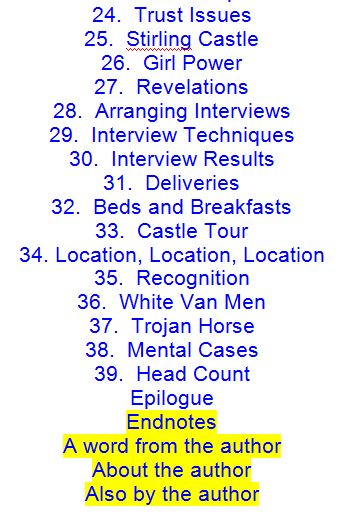
In the back pages of all of my eBooks I have supplementary information which includes: a short bio, and other titles.
We must ensure our bio is updated in all of our work as we produce another title, and we must ensure our latest title has all the others at the back.
Why at the back?
If you’ve published an eBook it will give more of a sample for prospective readers (customers), and the information is irrelevant if the prospective reader doesn’t buy.
This is marketing by stealth.
*
6. Book Pricing
Yes, we all love writing and we’d do it even if we weren’t paid. The flip-side of the coin is – while we can be paid, we don’t want to lose out. I abide by certain simple rules.
I have several titles out there covering a variety of genre and types of writing. I don’t consider myself a household name, so I price my work accordingly. Don’t set a high price on your first book, and don’t think a few five star reviews means you’ve made it and you can ask whatever price you like.
Keep in mind, there are thousands of e-Reader users who only download books which are free, or up to a certain price. We’ve all heard the phrase, ‘everyone has their price’, and it’s no different in the world of eBooks.
A few days ago I amended my pricing across the entire range of my catalogue. Always remember, it’s better to get 100 shares of a low price – rather than 2 shares of a high price.
*
7. Appointments
Whether you made them or somebody else made them – keep them. At one end of the scale an ‘appointment’ might be the date you’ve set to promote a book with a low price. At the other end of the scale an ‘appointment’ might be a phone call or meeting with somebody who can influence your success – or failure.
*
8. To be Read (TBR)
I’m well known for my methodical approach. 
On my Kindle I have a TBR – 1, and a TBR – 2. Apart from those, I have a TBR diary/journal which has all of the TBR 1 and 2 listed with genre and author name.
TBR – 1 is my priority list for reading and reviewing. TBR – 2 is my list of titles which I’ve collected as a matter of interest, but I’m in no hurry to get to them. Using my TBR journal I can decide which genre to switch to after a recent read. I tend never to read and review the same genre twice in succession.
*
9. Work in Progress (WIP)
When did you last look at your list of WIP?
I know there are many, who do as I do and work on various projects simultaneously, but we must set ourselves a time to remind ourselves what else we have and any ‘due dates’.
*
10. Take regular breaks
Yes, obvious isn’t it – but do you do it?
I work in retail part-time, so many of my days are hard-working, writing days. I enjoy a coffee while I work, but I am disciplined regarding breaks.
On an average writing day: By 7am – I’m already writing. By 10am – I’ve taken out an hour to deal with my first pass on social networking, so I take a 15-minute break (away from my writing). At 12noon – it’s lunch-time (for one hour).
At 3pm – I take my 15-minute afternoon break, and if my head isn’t in another world, I make a second pass on my social networking. At around 6 – 6.30pm I stop for dinner. I make a third pass on social networking in the evening.
Yes, that is the perfect day, but there are anomalies. I have the occasional coffee while I work. I will invariably come back to writing for an hour or two in the late evening, and I occasionally use a ‘break’ to catch up with social networking.

*
So my friends there we have it – we all need some refreshment in our writing lives.
I hope I’ve reminded, educated or inspired in some small way. As always, comments are appreciated and all will be acknowledged.
***


 tombensoncreative.com