
Knowing that it would be a time-consuming task, and would require planning, I created a brainstorming sheet. This is an idea that I’ve used for creating the foundation of all of my novels. For my personal military story, I drew a circle in the centre of a sheet of A4 paper and wrote my name in it.

I next drew a number of circles around the first, and connected them all to the centre one with lines. In these secondary circles I wrote topics like childhood, school, friends, family, work, colleagues, social, hobbies, and dreams.
From the ‘dream’ circle I extended more lines and drew more circles which contained Army, Royal Signals, training, adventure training, units, dates, colleagues, courses, N. I., Gulf War, promotions, single years, married years, cars, and a few other topics that seemed relevant.
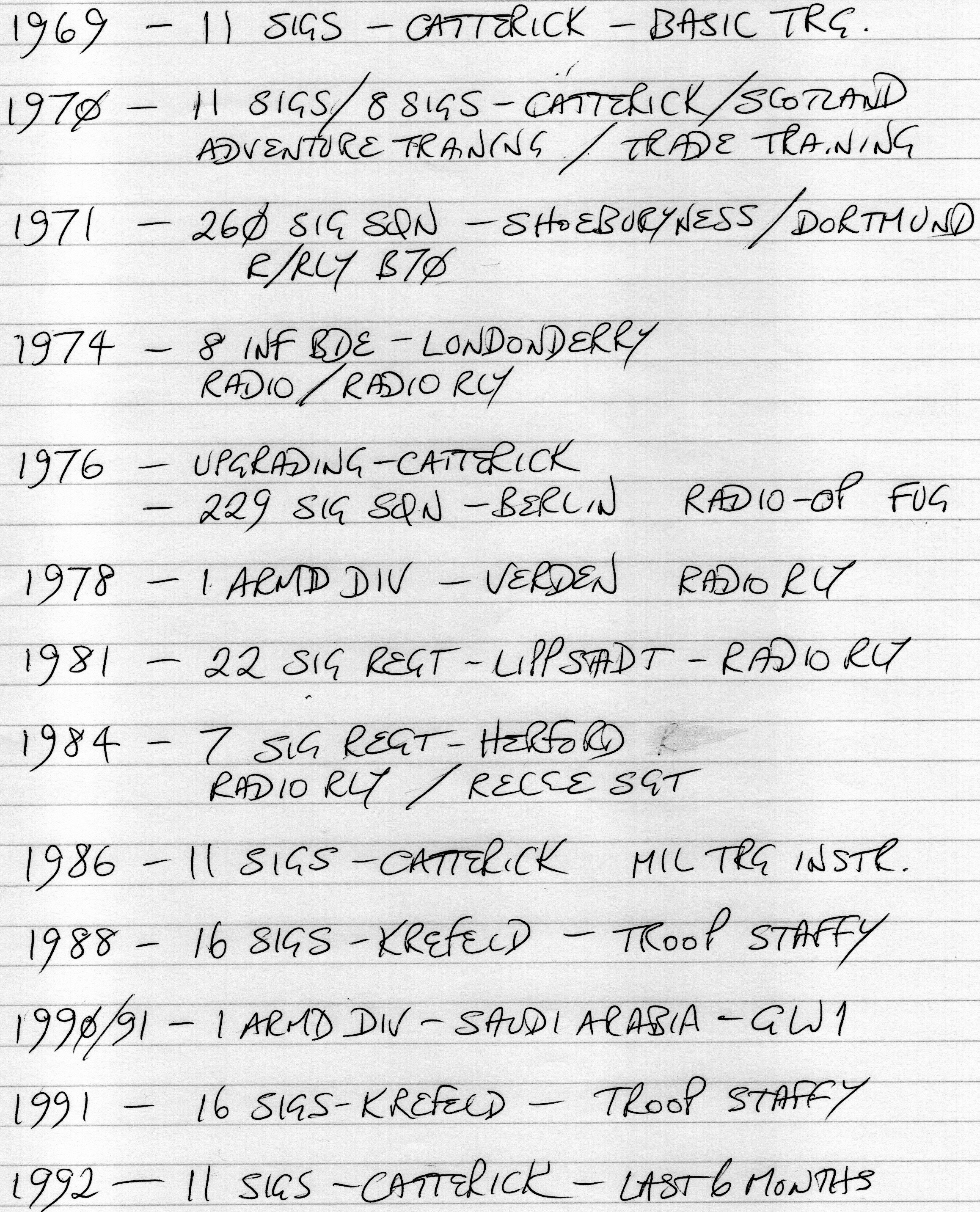
I listed the years from 1969 – 1992 down the side of an A4 sheet, leaving lines between each year. I listed where I was serving at any given time, including the unit name, and my role.
My next task, which took a considerable time, and saw me returning to it regularly for days, was the listing of names of all those I’d met along the way from school until my discharge from the army. I used one sheet with headings like childhood, school, friends, family, and work colleagues.
The next list was much longer and needed several sheets. Once again, I listed the units I’d served in, but starting with basic training. I listed the ranks, names, approximate ages, and hometowns of all those I could recall from my service.
For all the names on those lists I’ve mentioned, I kept the detail to the left of the sheets, so that opposite them I could create a new name and hometown for every individual.
Once again, I used a list of years from school through to when I left the military, but listed under these years were simple notes to remind me of funny, serious or peculiar occurrences. It will come as no surprise that most of my funny or peculiar incidents were listed among my army years.
I’ve always been a keen reader, so I knew there would be certain aspects of grammar, punctuation and so on that I’d have to learn. Dialogue for example would be used throughout my story so that it wouldn’t look like a journal. I bought The Writers abc Checklist, Write Right, and Perfect Punctuation. I still have those three books on a shelf among many other text books.
Before writing a word, I read the appropriate passages in my new text books to get a basic grasp of writing dialogue, and what the pitfalls were when using punctuation.
***

 tombensoncreative.com