
E is for … Eagle


E is for – Elephant, Eel, and Eagle. We’ll look at Eagle.

Eagles are known to vary in size, but when the word eagle is used it usually conjures up visions of the Fish Eagle, Bald Eagle, or Golden Eagle. These birds are without doubt the royalty of our feathered friends.

They are regal in pose and stature, and are the most powerful of all birds of prey.

***

Eagle


Species: There are 59 species of Eagle which are broken into four recognisable groups.

1. Serpent or Snake Eagles are the smallest sub-species.

2. Buzzard / Woodland Eagles, have longer tails, but shorter wings.

3. Sea Eagles, which are among the largest and specialise in catching fish and turtles.

4. Booted Eagles like the Golden Eagle.

Size: From pigeon-sized Serpent / Snake Eagles up to the Golden Eagle which can weigh in at around 20lbs and have a wingspan up to 8ft.

Habitat: The range of nesting sites is dependent on the bird, so the smaller species will be found in rock crevices, woodland and high altitude forestry. The Sea-Eagles will nest on islands, high in trees or cliff-faces. The Golden Eagle nests high in mountain ranges.

Location: The eagle in its various forms inhabits the entire planet and every continent has its home-grown specialised eagle.

Diet: As might be expected the range of food is as widespread as the birds themselves. The larger the bird – the larger the prey. Serpent-Eagles are small and will take small snakes and rodents. Rabbits and similar small animals are a favourite with most eagles. The Golden Eagle and other eagles of a similar size will take lambs or deer. Like all birds and animals they will go for smaller prey in times of need.

Predators: Once again mankind can take the credit for causing harm to these wonderful birds. The theft of eggs is only a problem for the smaller species, but the greatest hazard overall is caused by destruction of habitat. The birds have few natural enemies.

Info / Strange Fact: Being eagle-eyed is not simply a phrase. The eagle has increased components within the structure of its eyes. To put this in perspective, the Golden Eagle can see a rabbit at 2 miles distance.

*****


D is for … Dolphin


D is for – Dingo, Dolphin, and Dipper. We’ll look at Dolphin.
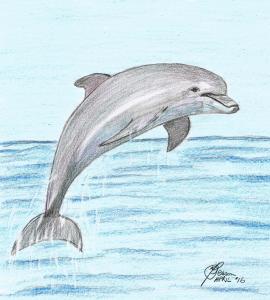
Dolphins are highly intelligent animals and have acute hearing, in or out of water. They are known to be sociable creatures, but like so many others, the males will become aggressive when in competition for a female. (Yes, don’t we know all about that aspect of life).

Having fought to get the female, the male (bull) relinquishes all duties regarding the young calf, which it leaves in the care of the mother (cow).

Dolphins have been responsible on many occasions for saving humans from shark attacks and, the dolphin’s ‘beak’ is a considerable weapon when used as a battering ram.

A group of dolphins is called a ‘school’ or ‘pod’.Dolphin

*****

Species: There are 40 recognised species of dolphin. Porpoises are mistakenly thought by some people to belong to the dolphin family, but, they are a separate group entirely.

Size: Due to the inclusion of Killer Whales in the Dolphin family, the size differential is extensive. The creatures of the many species referred to as ‘Dolphins’ are on average 5 feet long from nose to tail. Killer Whales (Orca) will grow to around 30 feet long.

Habitat: There are oceanic dolphins and river-based dolphins.

Location: Dolphin species of some description can be found in almost any open sea or oceanic area of the world.

Diet: Fish and Squid are the staple diet, although the Orca (Killer Whale) will take seals, or small whales.

Predators: Dolphins are actively hunted in certain places (Japan and, The Faroe Islands). Numbers are depleted regularly by mankind through pollution, accidents with boats and, bycatch (being caught in nets and drowning).

Info / Strange Facts: The inhabitants of Tahiji in Japan and those of the Faroe Islands consider the dolphin as food. There is a level of karma, in that dolphin meat is high in mercury, which is of course poisonous to humans.

In Laguna, Santa Catarina, Brazil, dolphins assist the local fishermen by driving the fish towards the shore. The dolphins take the fish which escape the nets.

The idea of a Military Marine Mammal Program (MMMP) has existed for over 50 years. The USA and Russia have conducted a variety of training and active service using Bottlenose Dolphins. Russia is said to have ceased the enterprise, however the US is open about the continued use of the animals.

The official training is said to be to locate persons in the water and to locate mines, however certain other practices are thought to be in existence, although not admitted.

*****