My original intention was to write Constance as a sequel, following on from the main character’s partnership formed with Jason in Crusader. I next considered Constance as a prequel, but the story will now be a standalone.
Not fully conversant with the differences?
A sequel is usually produced after the first story, film or whatever. A prequel is produced after the existing story, (in this case, Crusader), but the new tale is written about a prior time period. A standalone, unsurprisingly, may or may not be connected to another story, but can be read independently.
Why have I opted for individual stories instead of creating a mini-series?
My intention had been to reveal Constance using flashbacks, conversation, documents, media, events, and suchlike. Instead, the story will introduce the character before she meets Jason, aka Crusader.
The Constance character is firmly established in my mind, so I know her back story, and how she interacts with others. My aim is to highlight Constance as an individual, although at some stage the tale will blend with the original. Her story will not end when she meets Jason; it will continue, featuring the crime-fighting heroine in her own right.
Fans of the ‘Beyond The Law‘, or ‘Codename‘ stories will be pleased to learn that well-loved characters will make a cameo appearance.
When I have a clear idea of a time-frame for beta reading, final edits, and publishing, I’ll give everyone a heads-up with a post here.
For those who are interested, Crusader is selling regularly, although thanks to Amazon’s restrictive practises regarding reviews, it doesn’t look that way. The book recently won a gold award in the Thriller/Horror category in the Connections eMagazine, and a bronze award for cover design. Needless to say I was delighted with such recognition, and publicity.
As always, thank you for comments, suggestions, and dropping by.
I’ve published short stories in a wide variety of genres, but before tackling a novel I think ‘long and hard’, which I suppose is a reasonable euphemism for writing a novel.
Many authors who write sci-fi, dystopian or apocalyptic naturally populate their world with those creatures with whom we are most well-acquainted—humans. If not human, the characters are invariably a variation of the model. The unbelievable can be found in any genre but, in sci-fi, dystopian and apocalyptic stories, we as readers must more readily ‘accept’ the author’s word—it has to be convincing.
Apart from reading pretty much anything I also write in a broad spectrum. Although my sci-fi short stories have been well-received, for a long time I’ve wanted to write a novel with a sci-fi/dystopian/apocalyptic flavour. I was afraid of being drawn into a world of unpronounceable equipments, scientific jargon, strange weaponry, beams, time warps and goodness knows what else.
Two writing theories came to mind. ‘Write what you know’ and ‘ordinary people in extraordinary circumstances’. Now, here were two things I could work with in my new venture.
Alternative colour scheme
During my morning cycle rides when my surroundings permit, I let my thoughts wander and over many weeks I dreamt up a situation which involved ‘ordinary people in extraordinary circumstances’. If I’m writing ‘what I know’ then that as always will be down to memory, experience, knowledge and research.
My sci-fi/dystopian/apocalyptic novel has the working title ‘Light at the End’. Like most of my titles, this one carries more than one meaning.
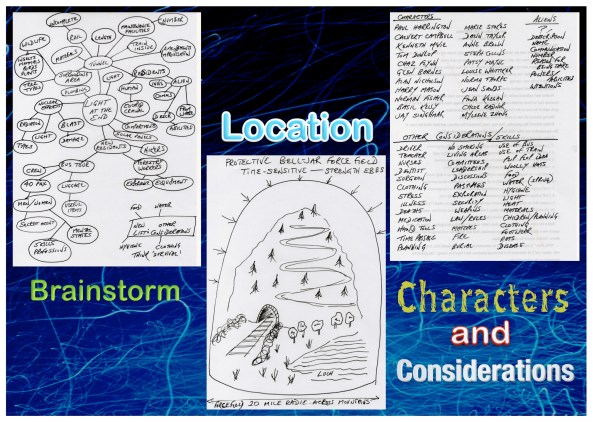
For the benefit of new writers or those who are interested in such things as how an author’s mind works when a new idea is bubbling under the surface, I used my favourite method for building the basics before writing any of the story. It’s a one-man brainstorming session.
– On a regular A4 sheet of paper, I drew a bubble and wrote the title inside.
– From this first point, I drew a line with a bubble on the end and wrote ‘tunnel’.
– From ‘tunnel’ I added several other threads with bubbles on the end—some of these immediately gaining their own extension.
– Back at the central bubble I extended more threads and added topics like ‘nuclear strike’, ‘tourists’, inhabitants’ and so on. Inside about thirty minutes I had thirty extensions from the original bubble—Light at the End.
– I spent twenty minutes listing character names and ‘other considerations’, writing as fast as possible when an idea came to mind. Speed is more beneficial than procrastination when brainstorming, otherwise it becomes braindrizzle. Characters would need names—not descriptions or ages—not yet, but male and female—yes.
I stopped the whole brainstorm session at one hour.
Result?
Forty circles with topics or sub-topics, and a list of forty ‘other considerations’.
While my thoughts were concentrated on the new story idea I had to keep pushing. Next up was another sheet of paper on which I drew a quick sketch of the tunnel and the surrounding countryside. By this stage, I was thinking of the opening scenes.
Before I stopped working I assessed progress.
A working title, a cover, a wide spread of information required, a plan of the main location, characters … and a catastrophe waiting to happen.
I performed the brainstorming session on Thursday evening and yesterday (Friday), I spent the day working on Chapter 1 – A Leap of Faith. Take a look and leave a comment if you wish. It’s a bit rough, due to being the first draft, which like the brainstorming was produced rapidly.
After much heart-searching, I’ve amended the sub-title/strapline from dystopian to apocalyptic. The two phrases are regularly and rightly associated, but I feel my tale will lean more heavily toward one than the other. Stranger than fiction really, since I’ve only written one chapter.
You’ve got to love being an author.
As always, thank you for dropping by, and for any comments or suggestions.




 tombensoncreative.com