 Let’s be honest from the outset, few folks are going to spend their cash if they can get something free of charge.
In the world of eBooks there are many reasons for titles to be offered ‘Free’ which include:
–an author’s promotion.
–a website promotion.
— a story to attract interest in the author’s work.
— pirate sources offering authors’ work free illegally.
How about paying a reduced price instead of aiming straight for the freebie?


Again, we have a number of reasons but now we’re being asked to pay so why would we choose to do such a thing?
 Instead of making a list, there is one main aspect I’d highlight. The author or the supplier is content that the product is worthy of being sold but for whatever reason, the price has been reduced. The onus is on the buying public to look at the reduction which is invariably explained to us in a brief message or if you prefer ‘sales pitch’.
 Personally, I’m sceptical when it comes to getting something for ‘free’, but I’m always happy to pay if I perceive a bargain. For example, if there were an eBook that caught my eye and I was getting it for a reduced price I’d buy it, especially if it were by an author I’d yet to try.
In this present climate of international lock-down, we have many thousands of people who are reading more or possibly reading for the first time in many years. Money is a concern, of course, so once again we’re back to that question of taking what’s free or pay, but not too much.
It was with this theory in mind that I created the eBook Bank International a few weeks ago. eBooks for 99p (or equivalent).
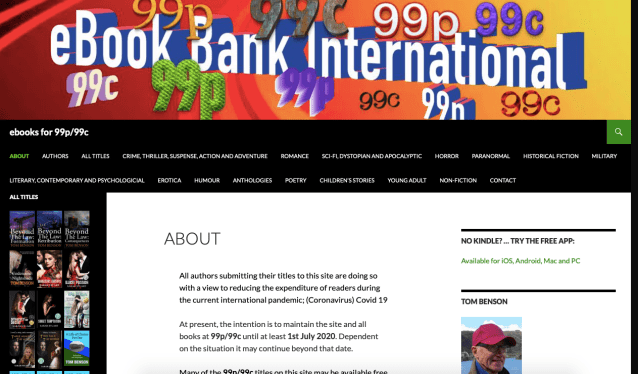
No, it’s not a promotional website for authors in the conventional sense, it is a place which has in excess of 120 titles covering a wide range of genres and includes 17 authors’ work. This is a site which promotes authors, eBooks and the idea that just for once somebody cares about how much money people can afford to spend.
Why is the website based on ‘selling’ for 99p (or equivalent) instead of just giving away our books?
 Imagine the number of people out there with an eReader who grab anything for free. Many of them will download titles they’ll never read but they got them for free–their only reason to take the book.
Now, imagine the number of people who might be prepared to pay but only a small amount … say, 99p for an eBook which is normally £2.49. Each title purchased is an investment by that reader and they will likely go on to read the book.
What do the authors get from reducing their prices but not making the titles free?
 Interest in their hard work is the first thing, and then, of course, a few sales due to the lower price. The authors involved in this venture may give up a small amount in the first place but they’ve made an investment–in readership. Perhaps their £2.49 title was competitive but the price still put people off and then that same book was offered at 99p … a win-win situation.
Again, on a personal note, I’d rather see a title sell fifty times at 99p than twice at £2.49.
In this post, I’ve featured a variety of my titles but there are many other authors involved in the eBook Bank project, so why not pay a visit and pick up a bargain for 99p (or equivalent).
***

 Okay, so you’ve written a book and you’ve got a cover.


 tombensoncreative.com