I loved the Sixties …

Of course, the twenties were incredible, the thirties and forties were fantastic, and the fifties were pretty good.

With effect from 7th November, I’ll embrace the Seventies.

It was 53 years ago that I joined the British Army, leaving home, and Scotland for the first time. The rest, as they say, is history.

I may have tackled my literary ambitions later in life than some authors, but I’m satisfied with what I’ve achieved thus far. 

I first tried my hand at creative writing in 1996, a few years after completing my military service in 1992. I wanted to record as much information as possible about my career, transcribing from notebooks, diaries, and official documents. I refreshed myself on how to touch-type, a skill I learned in the military. I produced countless pages of information, and tried over a short period to make it an autobiography, but the writing was awful for so many reasons.

As my next career (Retail Management) was taking off, I got back into reading, and some years later, in 2007, I bought books and magazines to study writing. I also joined websites that facilitated posting poetry, short stories, reading, and reviewing by all members. I next got underway with letters to magazines, and entering short story competitions. Success, apart from publication, included cash, book prizes, and inclusion in anthologies.
Since 2012, I’ve published novels, novellas, anthologies of short stories, and poetry collections. Between 2018, and the present day, with the exception of erotica, I’ve converted all of my work into paperback. My output was increased when my retail career ended after 25 years. I had reached official retirement age (65) in 2017.

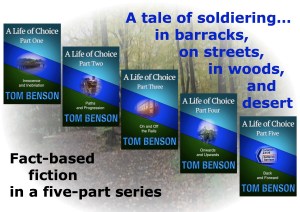
As seen in the graphic above, I eventually completed what had started out as an autobiography. I amended the story to be fact-based-fiction, changing names and so on, which removes any worry of legal action. Instead of cutting out large segments of the story, I concentrated on making it an easy-to-follow, cohesive read by creating five logical phases to cover the time period. I then spent a year fine-tuning the end product one part at a time. The eBooks were published over 2016 and 2017. I returned to the manuscript, and, once again using logical phases, produced a paperback trilogy so that in either option, the story is the same, word-for-word. I’m delighted to report that they are among my top-selling titles.

What are my intention for the future?

My Work in Progress consists of four more crime thrillers, a sci-fi fantasy, and another anthology of short stories. When all of those have been published I may cease to produce new work.

I’m a firm believer that as authors, even after that final edit, and a book has been on sale for a while, we know there will be an urge to return to it. I’ve learned so much as time has passed, and my writing and style have improved. I’ve already revised most of my titles, but when the final one is published, I intend to reread each of my books, and improve them wherever possible.

Click here or on the banner to visit my author website.

There are so many things said about age, like it being, ‘but a number’, ‘sixty is the new forty’, and so forth, but for me as an author, each year creates another level of life experience, appreciation of all things, and a deep desire to improve, and entertain with my writing.

Updates here will keep readers in the loop regarding my progress. At some point while reading my catalogue, I may dream up another literary offering, but we’ll see.

Once again, I thank all of you who have helped make my lifelong writing dream a success.

 ***

Sex … In or Out?

You’ve written a great story. Do you need sex amidst the guns, fighting and mayhem, the psychological trauma and mystery, or the tenderness and promises?

When I say ‘do you need sex’ I’m obviously referring to the requirements of the story—not your personal urges. I digress … .

This blog post was born from the need to offer my opinion on a regular comment I see on social media, and if we’re all honest, it’s getting a bit tedious. The comment usually follows similar lines to: ‘… and when I reach a sex scene I move on …’

There is usually a bit more to it, but in essence, we have two main areas to address.

Question 1 – Is the reader a prude, or simply someone who knows when a sex scene could have been done more tastefully—if it were needed at all?

Question 2 – Did the author make a mistake by getting carried away, drifting from the primary genre, thus adversely affecting the plot of the story?

The answer to Question 1 is not as simple as it sounds. For some readers, if an author goes beyond: ‘… she stood with her back to the door and raised an eyebrow …’ it’s too much. For others, it’s frustratingly brief, and they want to at least know if one person is wearing matching underwear and if the other person is wearing underwear at all.

Now, Question 2 throws up a whole new dilemma. As authors, it is not simply a personal choice, but in my (humble) opinion, it is our duty to remain true to our craft. No, I’m not getting high and mighty because I’ve written more than two books—I’m simply telling it like it is. The reputation of indie authors is being destroyed from within by some people with low standards. Those of us who work long hard hours and go beyond the first draft must persevere to produce the best we can.

You cannot refer to yourself in your branding or promotional material (of whatever level) as a thriller writer if you have the main character kill someone and then for the rest of the book he/she beds every other person in the ‘adventure’. You can dress it up, or undress it if you wish, but one of the aims of any author should be to focus on the job—in this case, a good story based on the primary genre.

I write a wide variety of genre and among them is erotica. I may allow a kiss or a caress—even partial undressing in some stories but graphic, no-holds-barred sexual activity is kept for my erotica.

If an author writes thrillers, westerns, sci-fi or other genres there ought to be sufficient time invested in character development, dialogue, imagery, pace and the accurate choreography of action. Any mention of sex will usually be incidental, except, of course, for romance, some paranormal and fantasy where it may go further.

An author who writes erotica is not out to shock—they are aiming to indulge their readers in the type of material they sought. This is not to say that character development and those other ingredients I mentioned earlier are not required in erotica—they are just as important. The erotica author must avoid sex becoming the ‘story’; an opportunity to be self-indulgent with repetitive and meaningless scenes of gratuitous carnal jiggery-pokery (mainly pokery).

In my ‘mainstream’ genres, there may be terms of endearment, a kiss or an embrace but they are strategically placed. Occasionally, in my erotica, there is less need for such romantic overtures, activity or subtlety. The characters might be more interested in mutual physical gratification than an emotional rollercoaster ride but there will still be character development and the activities are created with a purpose. It depends on the story.

I believe the author should strive to be faithful to the principle genre and whatever extended subjects it entails whether it be an action-packed or psychological plot, and plot or character-driven.

If you’d like to see ‘erotica’ as it once was, read ‘Lady Chatterley’s Lover’. Like most other genres, erotica has moved on and readers are no longer satisfied with what was once considered shocking—people want to envisage themselves in scenes which will (in most cases) forever be a fantasy. With the greatest respect D.H.Lawrence, move over my friend.

I’m a great believer in the use of metaphor if it spells something out clearly. I’ll summarise with two questions to authors who are trying to work out if sex ought to be highlighted in a story?

Would you wear flip-flops and boxing gloves to run a marathon, or perhaps mask, snorkel and flippers to ride a bicycle?

Let’s be honest—if it doesn’t look right, it doesn’t belong.

Thank you for reading, and any comments.